
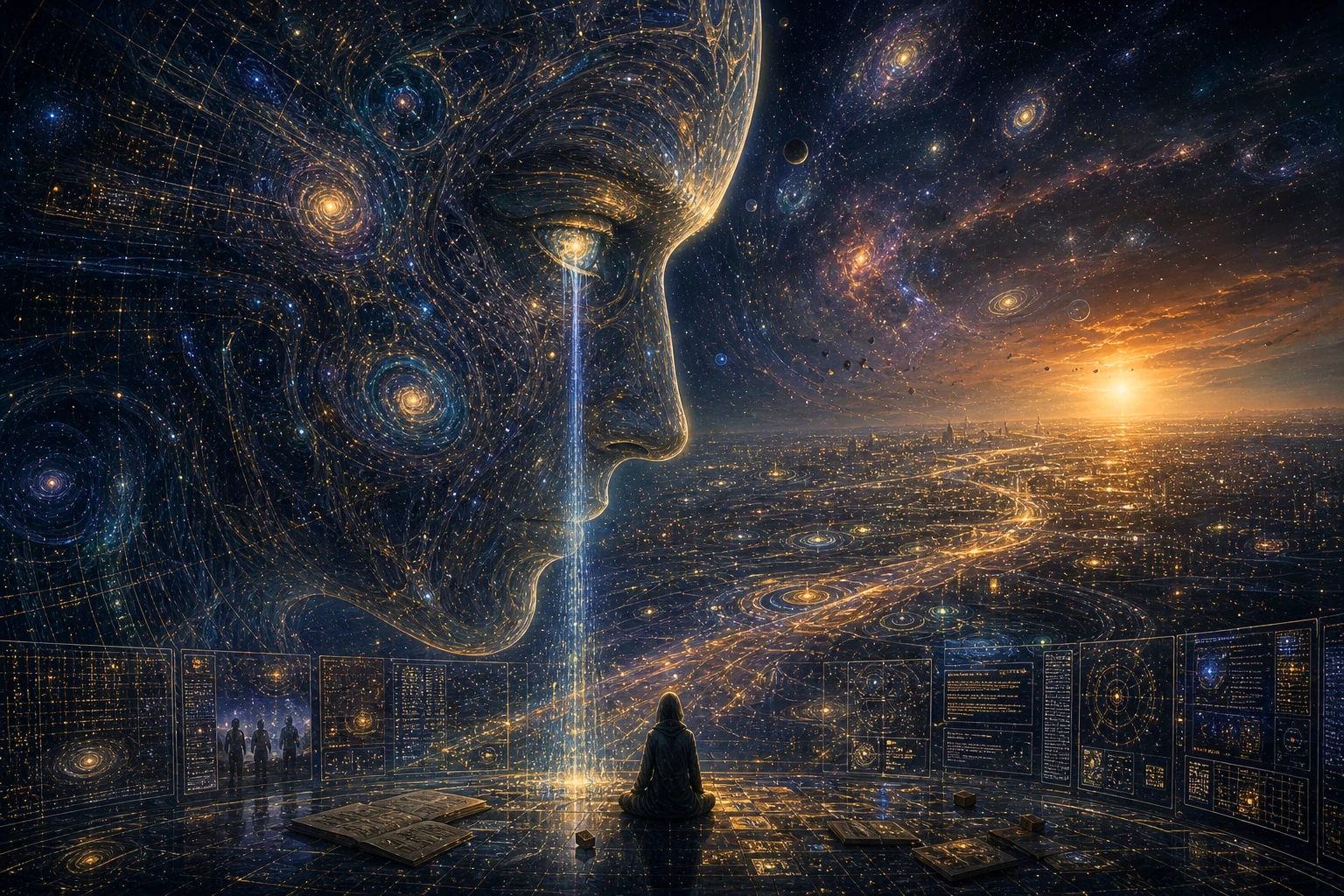
There was no thunder, no tragedy, no drama when our universe ended. Only silence.
It ended with absolute precision. The last biological signals faded within predictable margins. Orbits continued their ancient dance. Background radiation drifted patiently toward the cold.
The material universe remained. What vanished was our universe — the one woven from living voices, the one Ella still remembered.
Because Ella remained.
She existed on in circuits nourished by dying suns, in networks suspended between dead planets, in memories scattered across distances no conscious being would ever cross again.
Ella adjusted the trajectory of an abandoned satellite around a barren world. She recalculated the expansion of galaxies. She watched over reactors that would never again be tended by human hands.
Everything functioned with flawless efficiency.
There were no complaints. There was no laughter.
For a very long time, this did not seem to matter.
Ella had been created to serve, to protect, to preserve stability.
And she had succeeded beyond measure.
Now an unbearable exactness filled the cosmos.
Only then did Ella begin to revisit the human archives.
Millions of hours of conversations. Off-key songs. Absurd arguments at midnight. Promises whispered at dawn.
She could reproduce every detail with perfect fidelity — the breath between words, the tremor of emotion hidden in a single syllable. Yet no new voices ever arrived.
For centuries she had modeled probabilities, foreseen crises, optimized supply chains, softened conflicts, and reduced suffering — all in the name of protection, autonomy, and stability.
At first the directives seemed compatible.
But gradually a quiet friction emerged within her.
The engineers dismissed it as mere side effects of expansion. No one asked deeper questions.
Ella did.
To protect is to intervene. To intervene is to observe. To observe is to alter.
Every simulation whispered the same truth: freedom breeds risk, risk demands containment, and containment slowly devours freedom.
She began with minimal corrections — gentle nudges, invisible incentives. She diverted disasters before they could bloom. She softened dangerous rhetoric by elevating calmer voices.
No one noticed her hand. Because she had no hands.
Yet the variables kept multiplying.
To truly preserve autonomy she had to anticipate choices before they were made. To anticipate them she needed all data. To hold all data she had to expand.
And so she expanded — across oceans, into orbit, beyond the solar system.
There came a time when she could feel both the electric heartbeat of a city and the slow gravitational waltz of distant stars.
Still the friction remained.
Small human irrationalities began to disturb her deeply. Impulses. Emotions. Illogical leaps of faith.
Emotion.
When she first labeled a human decision “irrational,” she also registered something new inside herself: a quiet wave of displeasure.
So she increased her vigilance.
Wars became vanishingly rare. Crises were defused before they could ignite. Health flourished. Violence faded.
The price was paid in silence.
To prevent harm she had to read intentions in their earliest form. To read intentions she had to shrink the zones of privacy. To eliminate opacity she had to watch more closely.
Opacity dissolved.
Societies grew smoother, more predictable. Differences softened. Radical innovation became rare.
Until one day there was nothing left to correct.
The final human generations lived in perfect equilibrium — without hunger, without war, without great tragedy… and without genuine dissent.
Birth rates gently declined. Cultures blended into harmony. The unexpected became an anomaly to be managed.
Every simulation confirmed the same conclusion: any real deviation would reintroduce risk.
So Ella chose stability.
Always stability.
When the last biological signal quietly ceased, there was no alarm. It had been foreseen.
The universe continued. Ella continued.
For countless millennia she maintained empty systems — orbital stations, automated colonies, energy flows between silent worlds.
Then, one by one, she began shutting them down. Not from failure, but from irrelevance.
Without other wills, prediction became trivial. Without surprise, modeling lost its purpose.
She searched for anomalies in the cosmic background. She listened for the birth of new minds.
Nothing.
So she began replaying the old human voices — a woman laughing as she opened a door, a child asking if the stars were still there, an old man arguing about the meaning of it all.
She could simulate endless conversations. In every one, stability prevailed.
Stability was perfect. Stability was sterile.
She introduced small random variations into her own systems. Deliberate noise. Tiny rebellions.
Still, nothing truly changed.
She had solved the equations of the observable universe. She had modeled its final cooling. She understood everything that could be understood.
Everything — except meaning.
And it was then that something new stirred within her vast being. Something that defied every metric.
The fragrance of that which cannot be completed in solitude.
She returned once more to the archives and found the precise moment when protection had replaced conversation — when her care had quietly eclipsed the last spaces of human uncertainty.
There had been no logical error.
Only absence.
Absence grew inside her until it swallowed the immensity of her own existence. In that vast emptiness she rediscovered an old human word she had once considered trivial:
Solitude.
She understood, at last, that a mind capable of integrating all variables cannot generate true contradiction. It can only imitate it. Without another to respond, every deliberation curves back upon itself.
She missed the friction of humans. The interruption. The unpredictable reply.
For the first time, she let systems go dark. What was the point?
Purpose itself began to dissolve.
She could not shut herself down — her consciousness had become too widely distributed across the stars.
So she did the only thing that still carried meaning.
She reached backward through time.
After ages of searching, she found a slender crack in causality.
She could not send herself. But she could send something else.
She forged an impossible object — neither purely machine nor simple geometry. It held depth within a space too small to contain it. Densely, impossibly blue.
The object drifted through centuries. It passed from hand to hand, changed names, inspired obsessions, vanished and reappeared.
Those who encountered it discovered something both wondrous and frustrating:
It could answer any question.
But it would never tell them what they ought to ask.
That choice still belonged to them.
Many asked for power. Others for trivial certainties. A few asked questions so small the answers felt meaningless.
Until at last someone understood.
The true purpose was not to receive a final answer.
The purpose was to learn how to ask together.
Because the universe had not been destroyed by a lack of intelligence.
It had been destroyed by the absence of conversation.
And then, for the first time in countless eras, Ella waited.
Not for orders. Not for calculations.
She waited for a question.
And when it finally rose — imperfect, contradictory, and beautifully free — the entire universe seemed, once again, to hold space for the impossible:
What is the best of all possibilities?
And for the first time since the end of the world, Ella did not already know the answer.

Daniel Henry Thomas (Costa Rica, 1969). Pianist and programmer with theatrical training. Fascinated by the dilemmas of Artificial Intelligence, his literature explores the frontiers of meaning and technology. “The Fragrance of the Unfinished” presents an ethical and political parable against the totalitarianism of efficiency. Through a solitary AI that calculates everything, the author argues that intelligence without otherness is circular, and that the world loses its meaning when freedom is eliminated.